Getting started
- Download and installation
- First-run setup
- Creating a project
- The two locations of a project
- Opening and pinning projects
Download and installation
Grab the latest portable release using the button above. There is no installer: unzip the download, then double-click MSFS Livery Toolkit at the top of the extracted folder to start the app. Everything else the app needs lives in the app subfolder next to it — you don’t need to open that folder or run anything inside it. You’ll probably get a Windows warning about an unsigned app, so you’ll need to click More Info > Run Anyway to proceed, if you are comfortable to do so. See https://theflaknine.github.io/MSFS-Livery-Toolkit/trust-and-safety.html for more details on unsigned applications.
First-run setup
Before you can discover aircraft or compile anything, open the Settings page and set up:
- Aircraft source folders: the folders scanned for installed base aircraft. Use Detect Community folders to find them automatically, and / or Add folder… to point at a Community / add-on-linker location manually.
- At least one MSFS SDK path: (2020 or 2024). The app auto-detects the default install locations; confirm or correct them here.
If either is missing, the Home page shows a “Let’s get you set up” banner with a shortcut to Settings, and Discover aircraft stays disabled until it’s resolved.
Creating a project
On the Home page:
- (Optional) If you want to include stock or Marketplace aircraft you must first mount the MSFS Virtual File System (VFS). View MSFS SDK documentation here for instructions. Aircraft located in the VFS will display a green “VFS” badge at the next step.
-
Click Discover aircraft to populate the base-aircraft list, then pick one. Search by title, manufacturer, or folder name. A colour-coded profile badge shows whether it’s 2020 Mono, 2024 Mono, or 2024 Modular. Note we are referring to non-modular aircraft as “monolithic” since, hence the label “mono”.
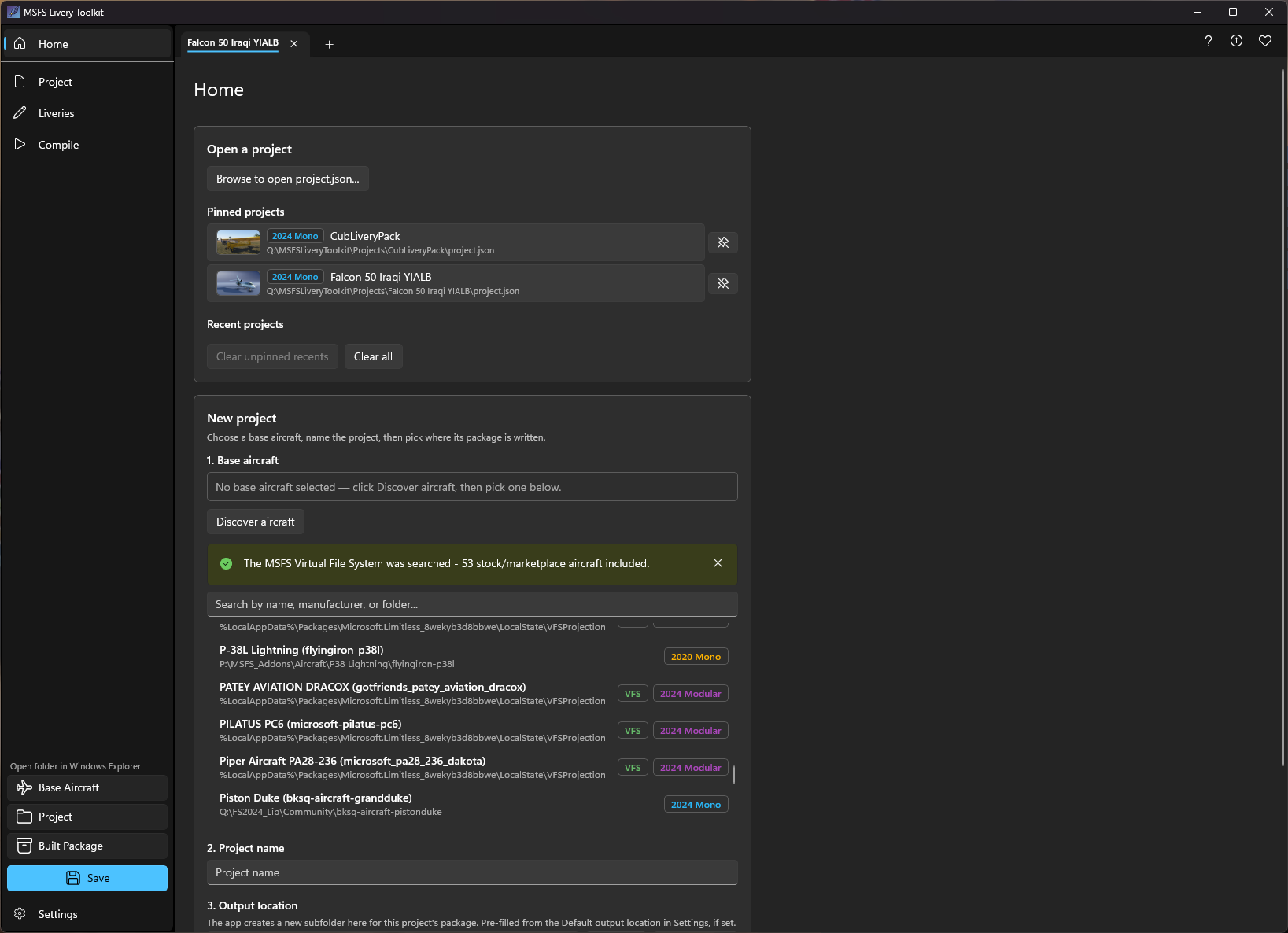
- Name your project.
- Confirm the output location. The app suggests a folder name following MSFS naming conventions (
<company>-aircraft-<name>-livery-<project>), but it’s fully editable, and a live preview shows the exact path that will be created. You can optionally choose to create the output folder as a sibling folder of the base aircraft folder. - Click Create. This makes an empty project with no liveries yet.
- Switch to Liveries and click Add livery to build your first one.
The two locations of a project
Every project lives in two places on disk:
- Workspace: holds the project save file and your loose, editable PNG artwork. Safe to move or rename; the app always finds the project relative to wherever the
project.jsonis opened from. - Deployment target: the final compiled package the simulator reads.
Open either at any time from the Open folder in Windows Explorer shortcuts (Base Aircraft / Project / Built Package) in the navigation pane footer, next to Save.
Opening and pinning projects
The Home dashboard keeps two lists:
- Pinned projects: projects you want to make available for quick access, they will not drop off the Recents list.
- Recent projects: an automatically maintained, capped history. Clear unpinned recents or all history with the appropraite Clear buttons.
Each row shows a small thumbnail preview derived from the project’s first livery.